01 · Opportunity
The opportunity appeared before the company was ready to build.
In 2022, while I was Product Design Lead, I researched unmet communication needs among roughly ten active commenters and passive readers. I explored richer audio and video replies, but one need stood out: conversations often remained valuable after the article that started them had disappeared from the news cycle.
That led to the earliest Forums concept: persistent, topic-based conversations hosted directly on publisher sites. The opportunity was credible, but building it required substantial engineering investment while the company had other priorities and technical debt. The idea was shelved rather than forced into a roadmap that could not support it.
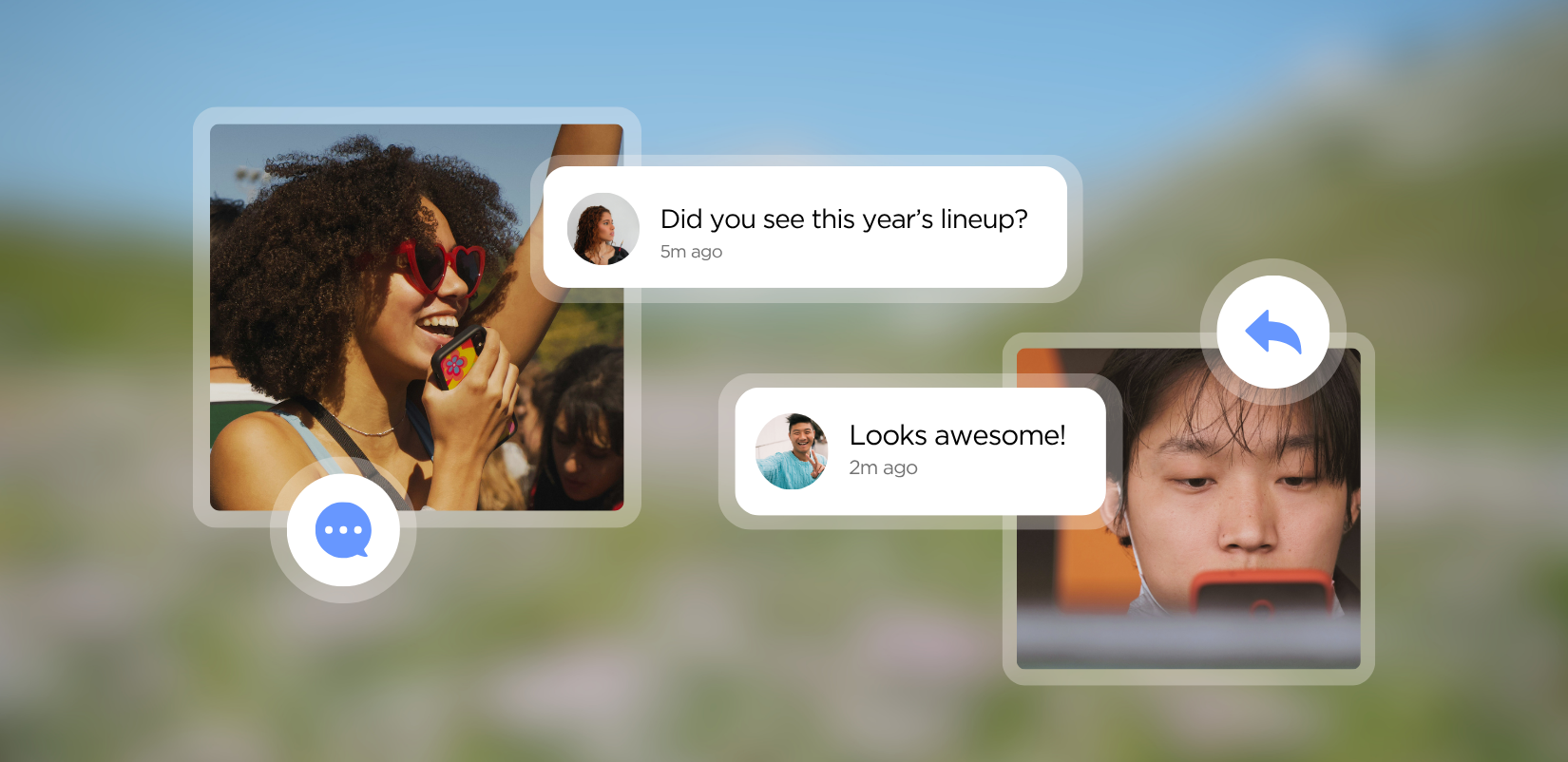
The article had a lifespan; the community’s interest often did not.
By late 2024, the investment window had changed.
Publishers were losing more of their audience relationship to Reddit, social platforms, and AI-mediated discovery. Customer-facing teams were also hearing stronger demand for owned community products that could generate first-party data, engagement, and monetizable activity.
The company decided to invest. Because I had explored the problem and shaped the earlier concepts, I was asked to take ownership of Forums.
Article comments create strong moments of participation, but they are tied to a single piece of content. Forums needed to convert those moments into an ongoing relationship.
If readers could discover active discussions and return to topics they cared about inside a publisher-owned destination, one-off article engagement could become a persistent community relationship.
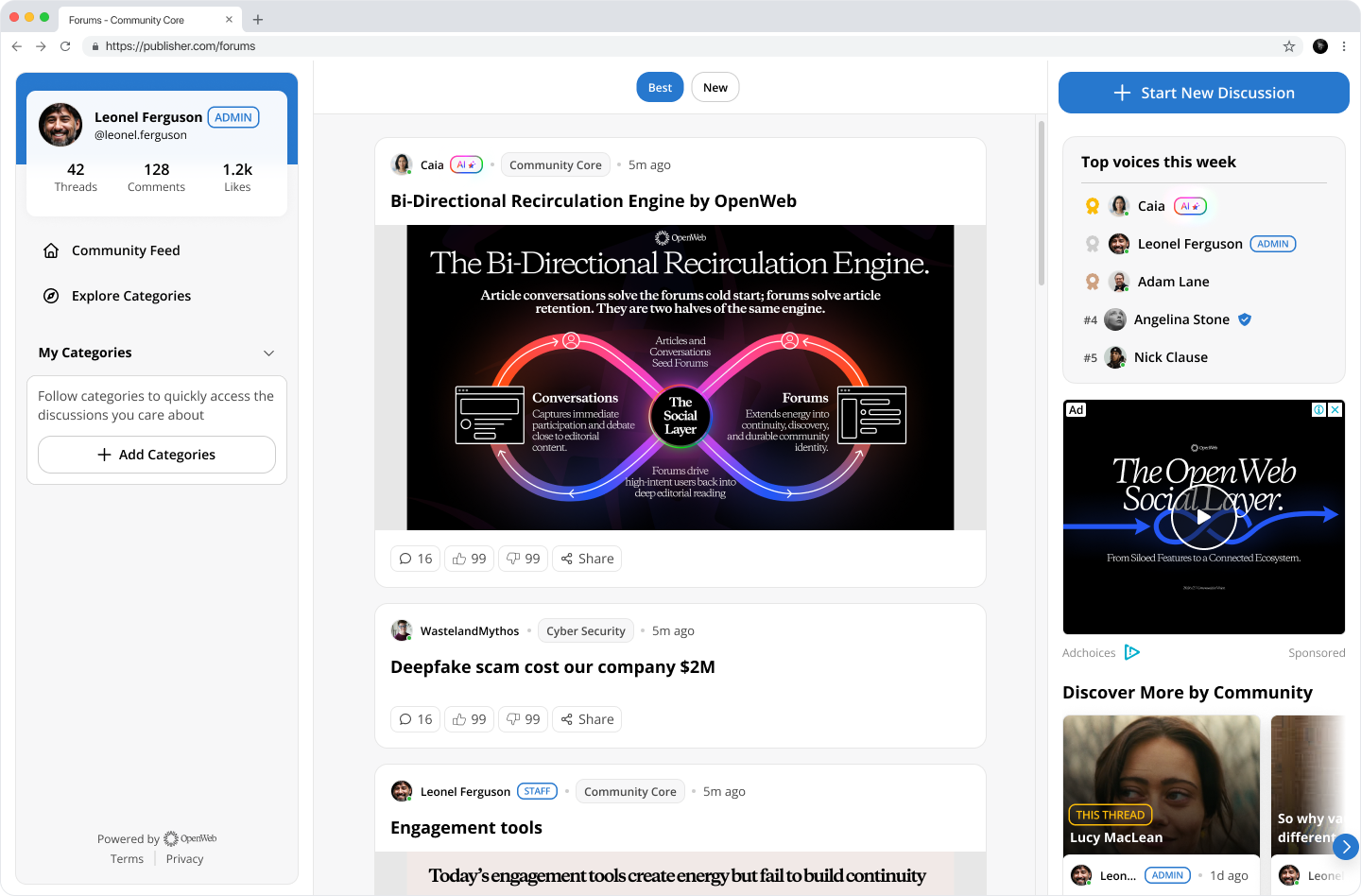
A persistent destination to discover discussions, follow interests, and participate outside an individual article.
Retain the audience relationship, first-party data, engagement, moderation control, and monetization on their own properties.
Expand from an article-conversation product into a broader community platform.
Forums would live on the publisher’s own domain, usually at/forums, while reusing OpenWeb’s existing identity, Conversations, moderation, and monetization capabilities.
The assignment
Moving from design leadership into product ownership.
Active development began in Q2 2025, when my manager asked me to take ownership of Forums. As Product Manager, I became responsible for defining the product from scratch and kicking off development with the Social team.
For a period, I operated across product and design: defining the strategy, MVP, requirements, priorities, user stories, and delivery plan while also producing the UX. As Forums grew, product ownership became a full-time responsibility and later expanded into ownership of OpenWeb’s wider Social product portfolio.
We did not have a dedicated product designer for much of the work. I created and iterated prototypes with Claude, Figma AI, and Codex. During the later redesign, I also contributed design-system components to the production codebase, keeping design capacity from blocking GA readiness.
- Role
- Product Manager
- Build
- Q2 2025–September 2026
- Core team
- Engineering lead, 2 frontend engineers, 3 backend engineers, QA
- Scope
- Discovery through public launch
Product vision, discovery, MVP definition, UX, requirements, roadmap, prioritization, beta strategy, adoption, launch readiness, and stakeholder alignment.
With no dedicated product designer for much of the work, I produced the UX, iterated prototypes with AI-assisted tools, and later contributed design-system components to the production codebase.
Define the product
- Define why Forums should exist and for whom.
- Decide what the first version needed to prove.
- Translate the product into buildable requirements and priorities.
Make it adoptable
- Establish how publishers would implement, configure, moderate, and operate it.
- Drive adoption among strategic beta partners.
- Turn beta evidence into the requirements for global launch.
02 · MVP
Two quarters forced a deliberately narrow first release.
Leadership expected us to define, design, build, and deliver a new product to beta partners within two quarters. The same engineering team owned several other products and could not dedicate even half of its total capacity to Forums.
The first partner-adoptable version therefore focused on feasibility, safety, and basic participation.
The first partner-adoptable version
- Readers could navigate, discover, and read threads.
- Registered community members could create threads.
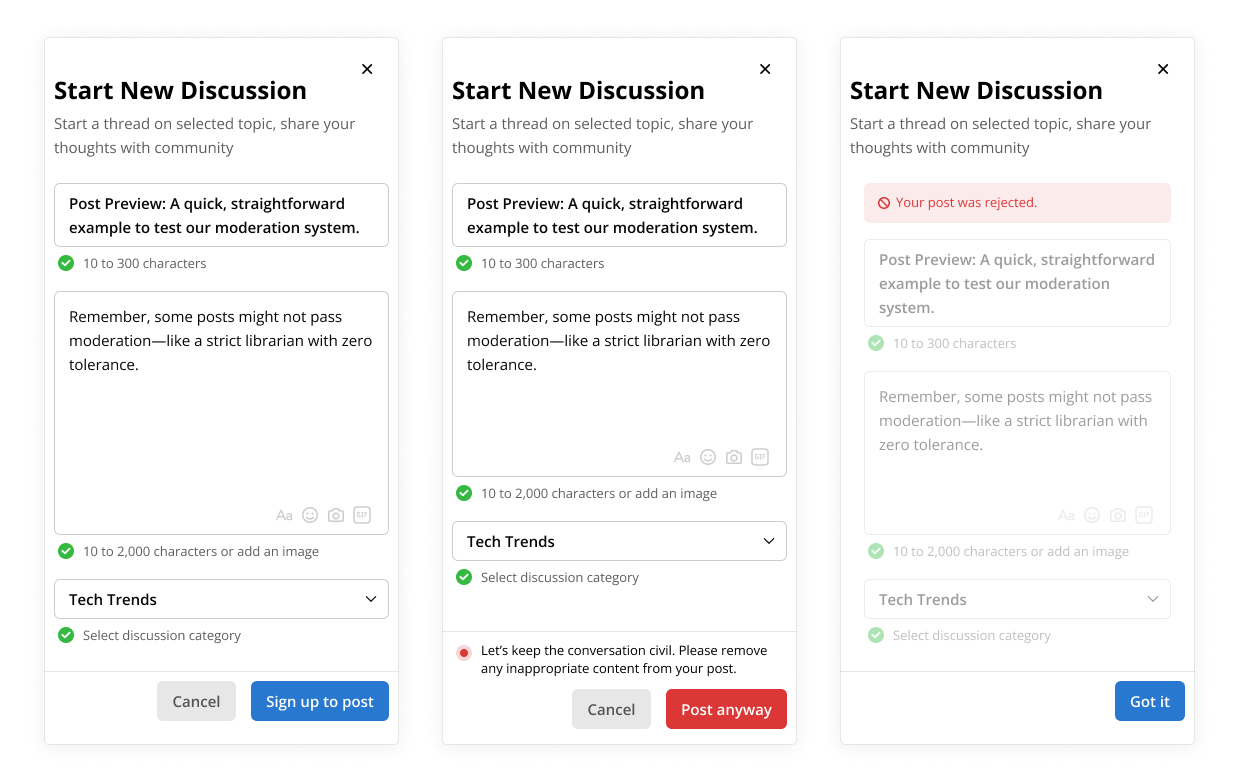
- Automated moderation screened thread starters.
- Authorized staff could reject published threads in Forums.
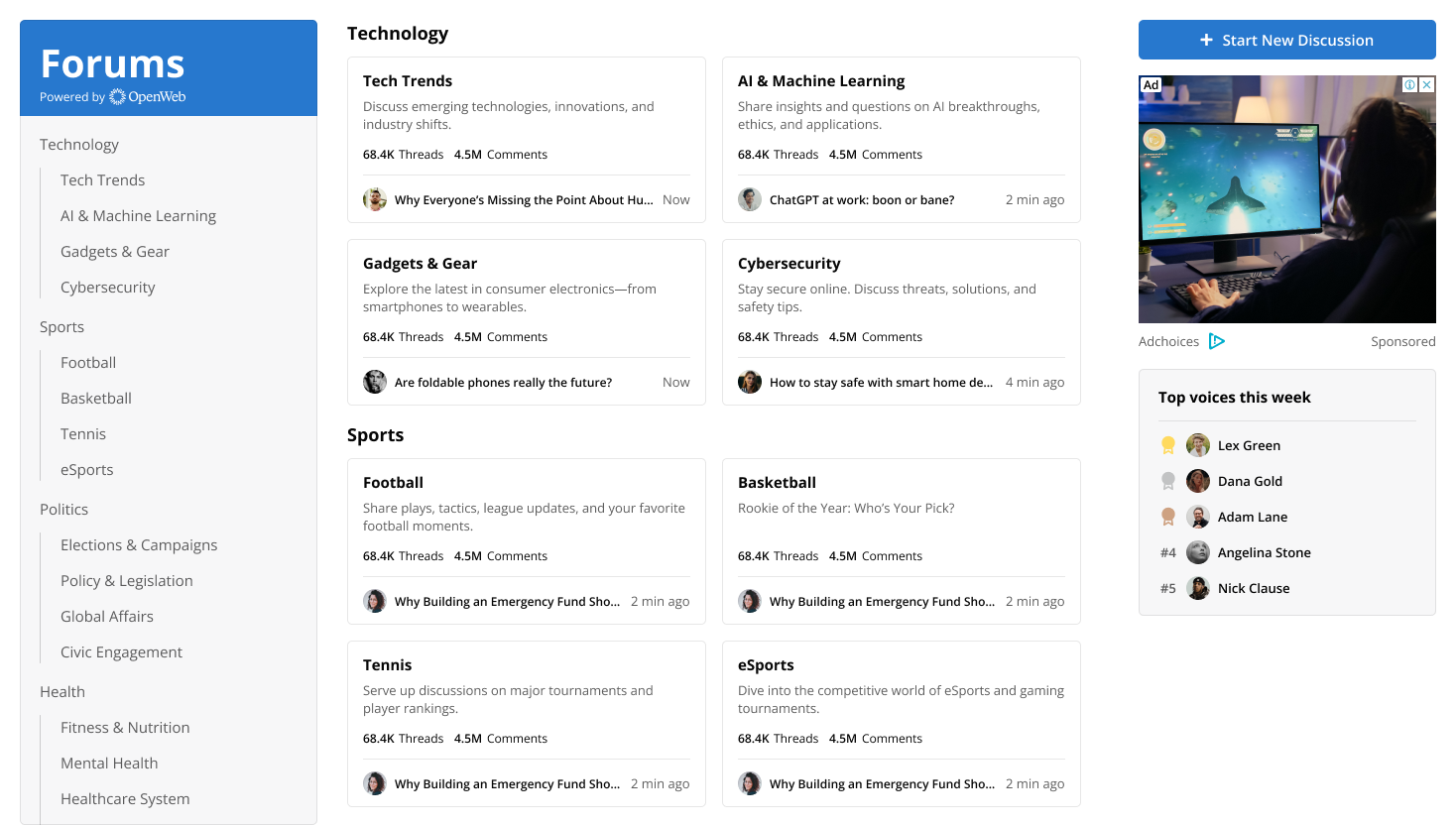
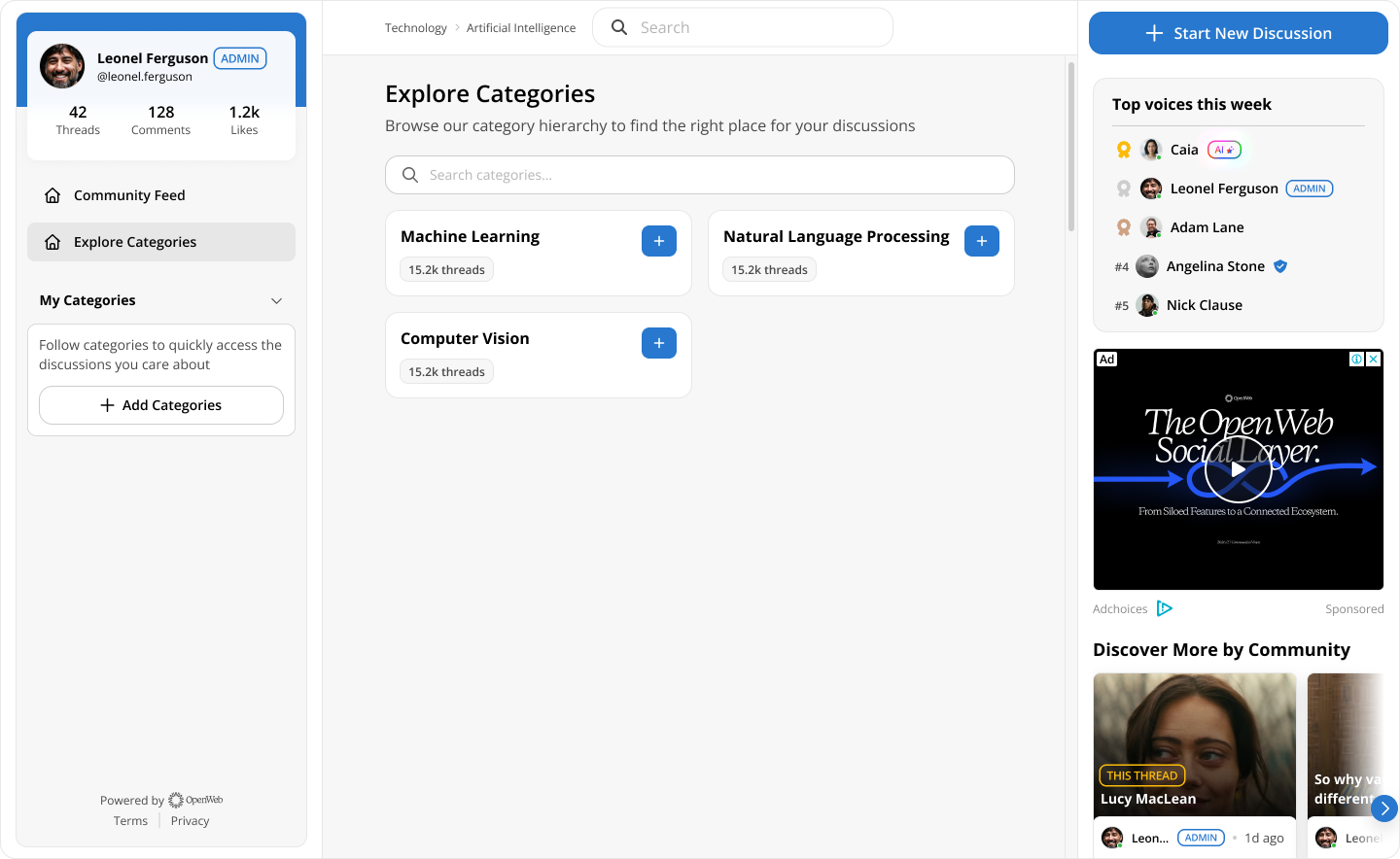
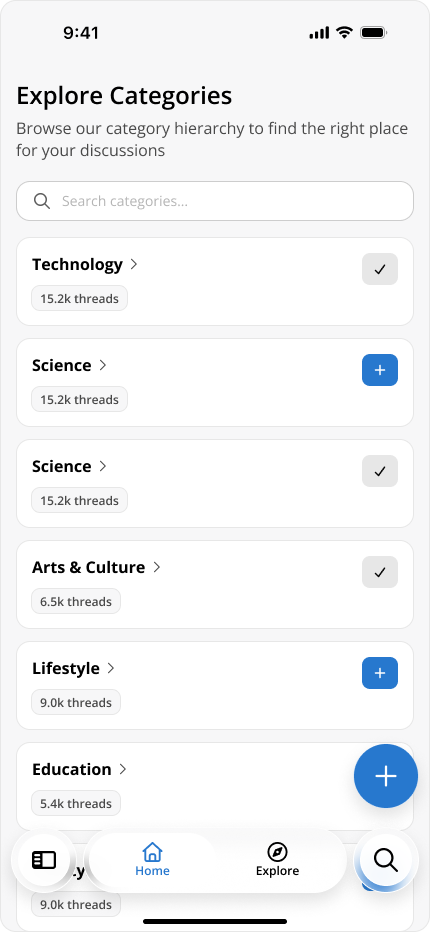
- Publishers could choose standardized IAB categories.
- Brand-color accents and dark themes supported host-site consistency.
We deliberately deferred
- Custom publisher taxonomies and administration.
- A sophisticated feed-first user experience.
- Localization across the 70-plus languages supported elsewhere.
- SEO-oriented server-side rendering and DiscussionForumPosting support.
The first interface borrowed familiar patterns from IGN’s existing Forums. I knew it was not the optimal long-term UX, but optimization was not the first question the beta needed to answer.
03 · Decisions
Three tradeoffs turned a concept into an operable product.
01
Protect the beta date, even at the cost of one desired partner.
IGN made SEO and DiscussionForumPosting structured data a primary condition for replacing its legacy forum. My research showed that credible support required rethinking OpenWeb’s embeddable widget architecture around server-side rendering. That investment could not fit the two-quarter commitment, still depended on correct publisher-side SSR, and offered no guarantee of indexing or ranking. I raised the risk to my manager and the CTO; we chose the existing client-rendered architecture and accepted that IGN would not join the beta.
Decision: preserve learning velocity over speculative scope.02
Replace a convenient taxonomy when it blocked adoption.
The first version used IAB categories because OpenWeb already classified articles against that taxonomy and Data Science needed a shared structure for the initial content-seeding experiment. Beta partners instead organized communities around brands, editorial coverage, teams, leagues, products, and local audience language. Because publisher adoption was one of my main KRs, I changed the roadmap to custom taxonomies and category-management tooling, despite weakening the simplicity of the original data model.
Decision: let publisher reality override technical convenience.03
Layer moderation instead of rebuilding a legacy workflow.
Brand safety was non-negotiable, but adding a new content entity to the legacy moderation product was a large-to-extra-large effort and would increase publisher operating costs while delaying every thread. I proposed a layered compromise: only registered members could create threads, OpenWeb’s strongest ML models screened them before publication, and authorized publisher staff could reject them after publication directly in Forums.
Decision: balance publisher trust, user speed, and team capacity.SEO was revisited when evidence justified it.
We later investigated dynamic routing, publisher-side API injection, and structured data. The content became technically accessible, but we did not see meaningful Google indexing, so I deprioritized further investment because technical feasibility had not translated into demonstrated business value.
The moderation compromise was monitored, not assumed.
When one publisher’s editorial posts triggered false positives, a deeper platform fix was not feasible during beta. We helped the team adjust the affected posts while continuing to monitor the risk. It was not a perfect system; it was a practical balance among publisher trust, user speed, engineering capacity, and the need to learn from a live product.
04 · Beta
The beta was a learning system, not a launch rehearsal.
The closed beta needed enough real community activity to reveal whether Forums worked. We prioritized publishers that already used OpenWeb Conversations, had at least 10 million monthly visitors, had meaningful returning-community volume, and would collaborate closely on implementation and technical validation.
Adoption was one of my personal KRs, so partner blockers became direct roadmap inputs. Sports Illustrated, FootballCo, Weather.com, and other partners influenced the priorities required to make Forums launchable.
Known adopters included Weather.com, Sports Illustrated, 9to5, and FootballCo properties including Koora, Goal.com, and Voetbalzone. Public examples showed publishers using Forums for persistent product communities and expert AMAs, not only technical validation.
What the beta had to reveal
- Could Forums run reliably in live publisher environments?
- Could readers understand and navigate the experience?
- Could publishers configure and operate it without heavy support?
- Could moderation protect both users and publisher brands?
- Which missing capabilities genuinely blocked adoption?
Cold start
A failed AI experiment led to a more credible system.
An empty forum gives new visitors no reason to participate. Our first response generated discussion starters from high-performing articles and comments. The system worked technically, but limited context could produce shallow or editorially misaligned posts.
Weather.com questioned whether the output matched its editorial voice. I stopped the experiment. Artificial activity was not worth weakening trust with publishers or users.
The replacement became the first skill of Caia, OpenWeb’s Community AI Agent.
We named the capability Autorepost. Instead of generating a synthetic discussion starter, it extended a real publisher article and its existing audience activity into Forums.
- 01
Detect early audience activity
A new publisher article had to reach an early-comment threshold before it could enter the Autorepost flow.
- 02
Match an existing Forums category
The article also had to match a category already configured in the publisher’s Forums taxonomy.
- 03
Publish through Caia
Caia created a corresponding Forum thread that preserved the original headline, image, article link, and comment thread.
- 04
Mirror the conversation
Comments remained synchronized between the article and Forums, allowing participation from either context without creating duplicate communities.
We stopped manufacturing the appearance of participation and began extending authentic publisher activity into a persistent community.
Community credibility mattered more than simulated activity.The rollout was limited, so I do not claim a quantitative uplift over empty Forums.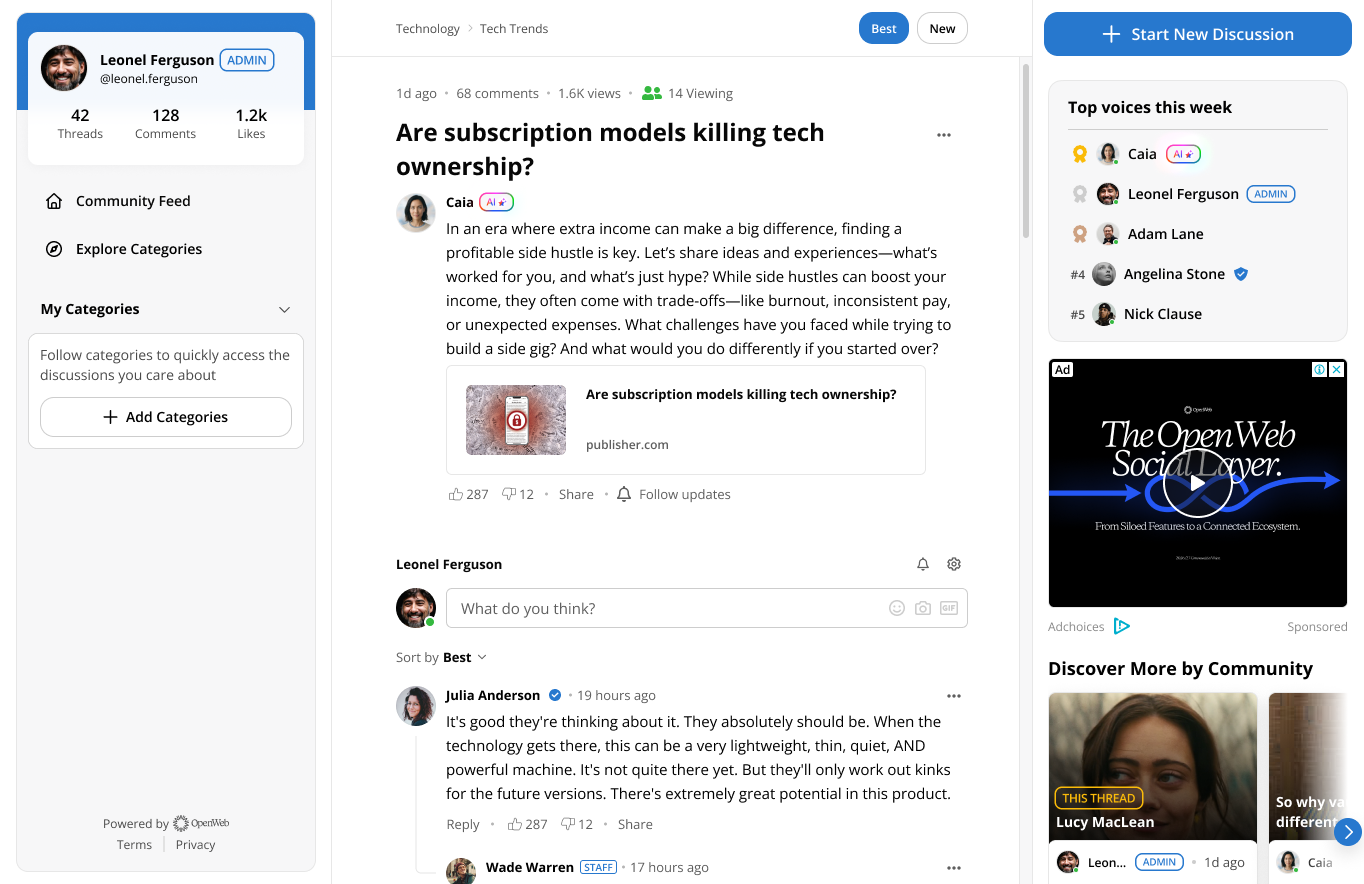
The redesign
Put active discussion before navigation.
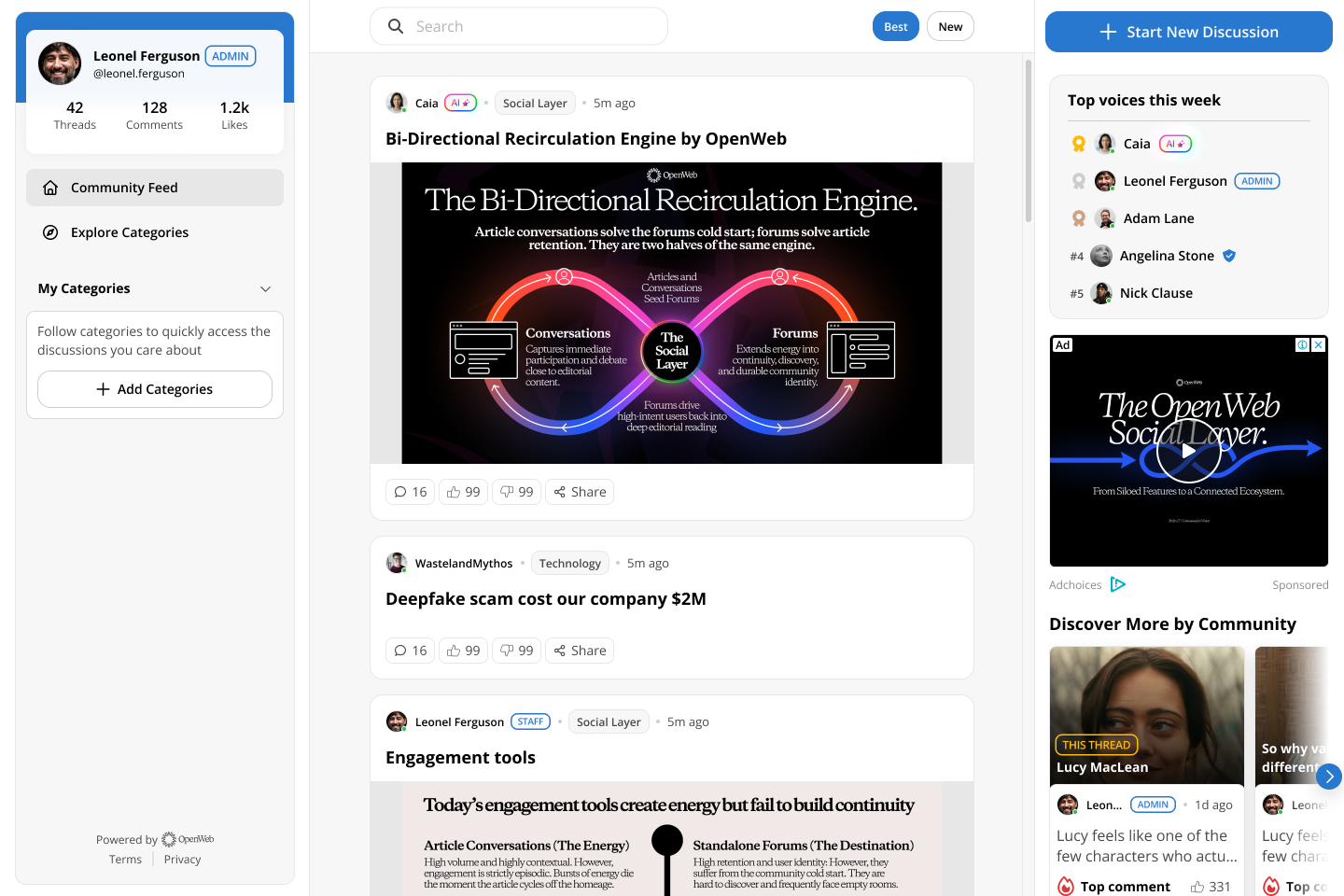
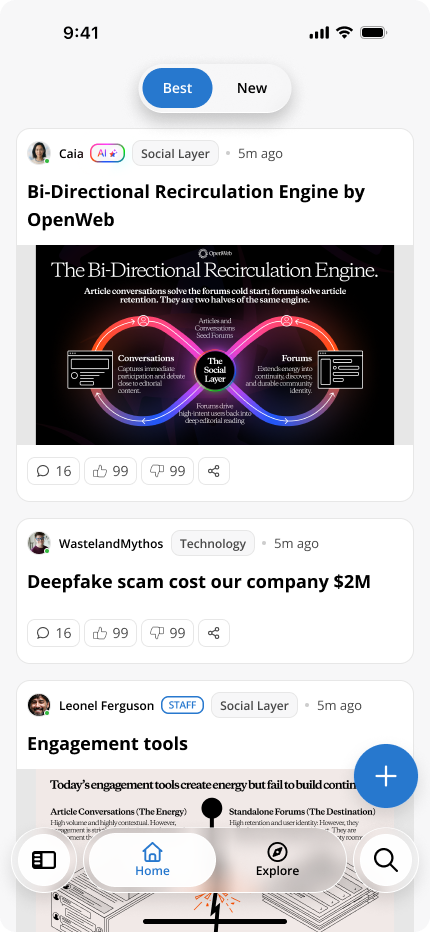
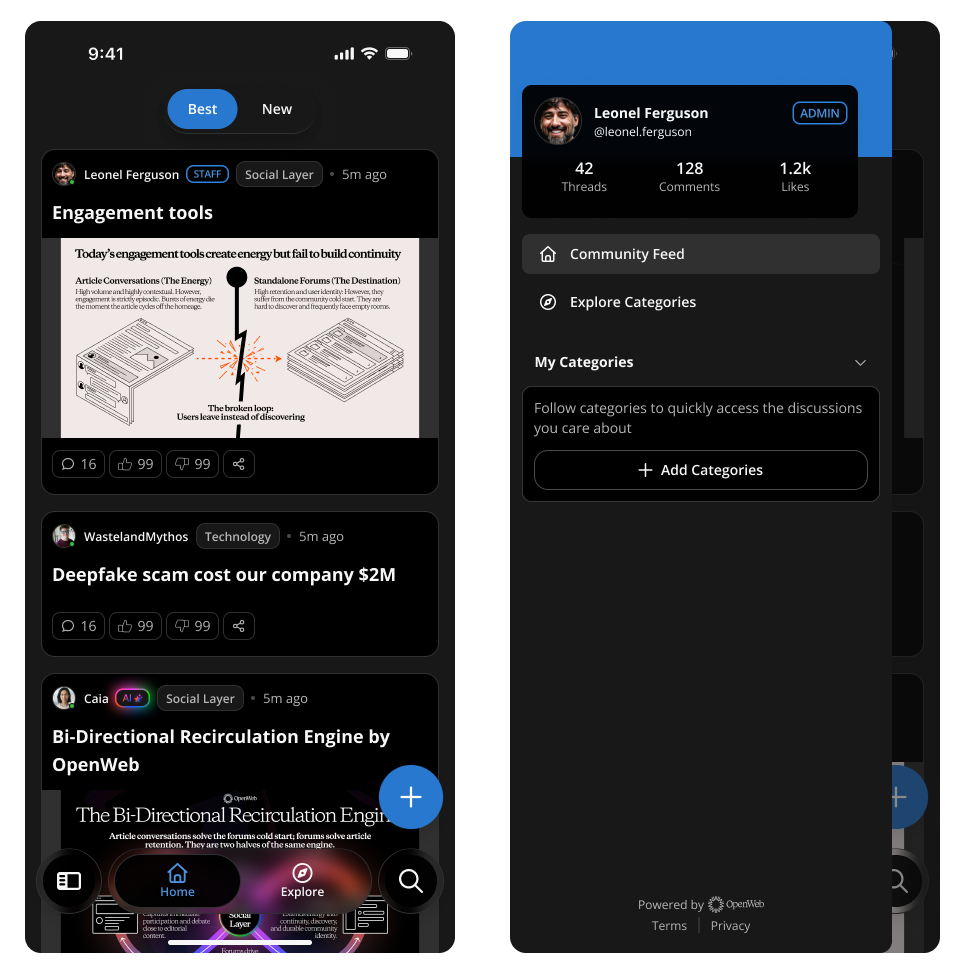
The first version worked, but very few visitors engaged with it. A common internal explanation was that Forums needed more content and stronger external discoverability. When I compared the analytics with the actual flow, I formed a different diagnosis: the homepage made people understand a taxonomy and make several navigation decisions before they saw a discussion worth reading.
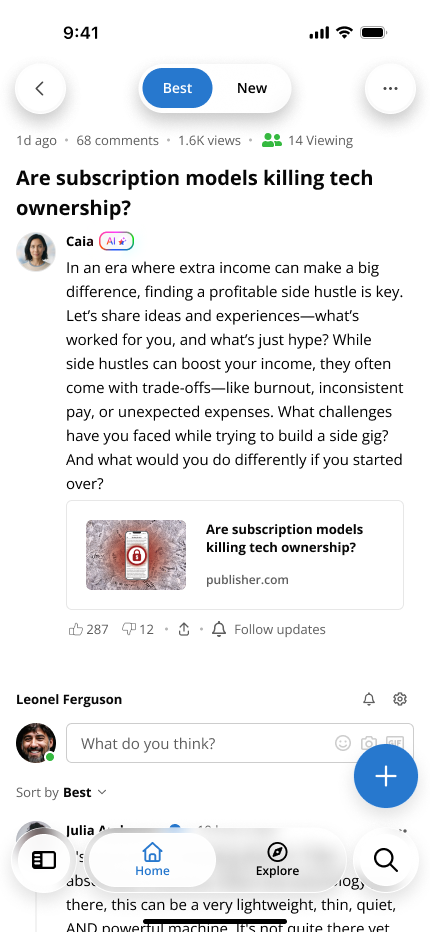
Roughly 80% of the audience was on mobile, so I initiated a mobile-first redesign. We replaced the category-first homepage with a ranked Community Feed, added My Categories for followed topics, preserved Explore Categories for deliberate navigation, and made member identity more visible through profiles and Top Voices.
I measured whether visitors opened a thread, navigated elsewhere in Forums, reacted, or scrolled the feed. After the redesign, the no-action rate fell and meaningful actions increased materially. I do not publish an exact percentage because I can no longer verify it against the internal analytics.
The product loop
Build a recirculation engine, not a competing destination.
A forum could not depend on a navigation link and hope that readers would return. The broader strategy connected articles and Forums in both directions: publisher content could create a credible entry point into Forums, while community activity could lead people back to relevant publisher content.
The objective was to make Forums part of the publisher ecosystem, not a separate destination that cannibalized the main content experience. Caia Autorepost, Recirculator, and publisher search each addressed a different part of that discovery loop.
- 01
Seed discussion with Caia Autorepost
Caia used content classification to route qualifying new articles into the best-matching Forums category, preserving the link between the article and its synchronized discussion.
- 02
Keep discovery moving
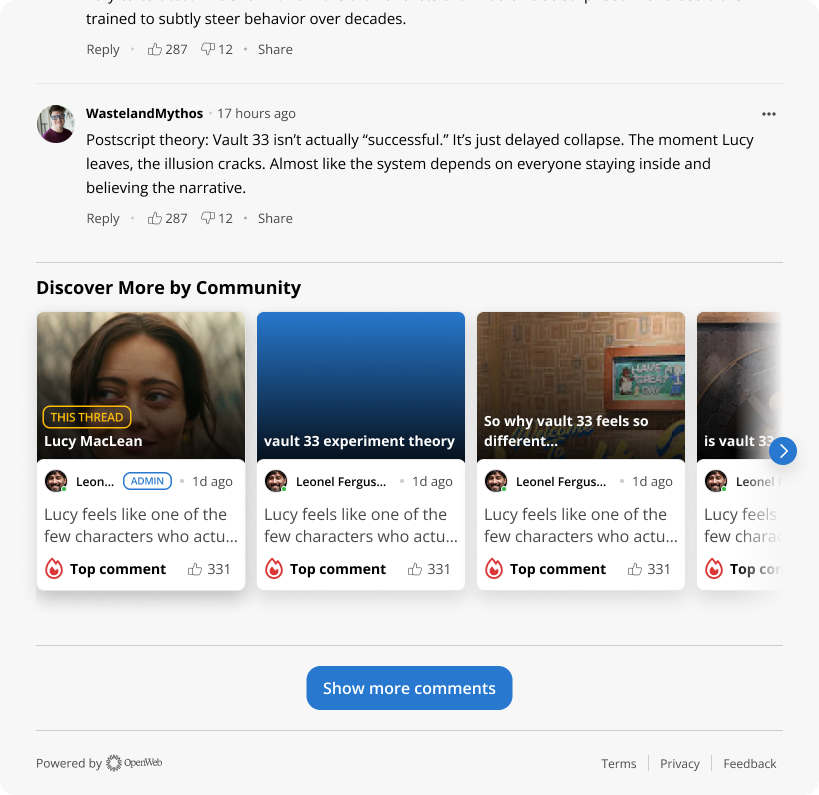
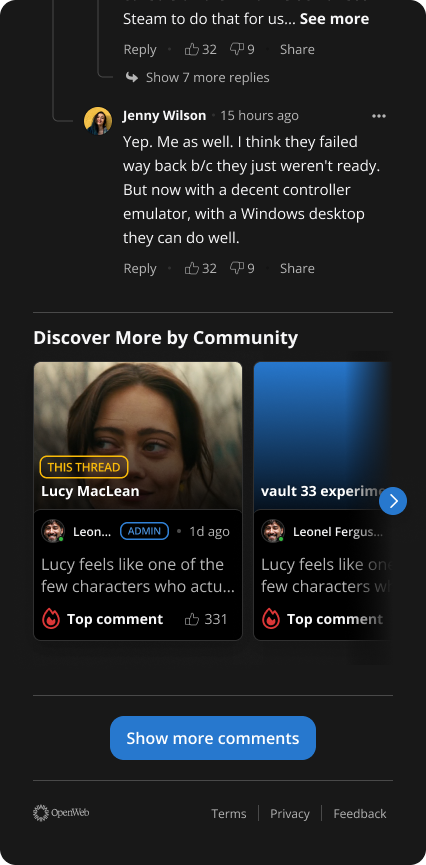
Inside article Conversations, the Recirculator used a Data Science relevance API to recommend related Forums discussions, creating a new route from article reading into the community.
- 03
Make the publisher ecosystem searchable
Publisher Ecosystem Search unified Forums threads, conversations under articles and inside threads, and publisher articles in one semantically ranked discovery layer.
- Publisher articleEditorial content creates the starting context.
- Caia AutorepostClassification routes it into the right community.
- Forum threadOne synchronized conversation persists in both contexts.
- Recirculator + Ecosystem SearchRelevant threads and articles remain discoverable.
- Next relevant destinationThe journey continues instead of ending in a silo.
Recirculator shipped near the end of my time on the product, so I do not claim an established impact result for it. Its importance here is the strategy: discovery should move readers across the publisher ecosystem instead of trapping them in a separate forum silo.
One search engine for the publisher’s entire ecosystem.
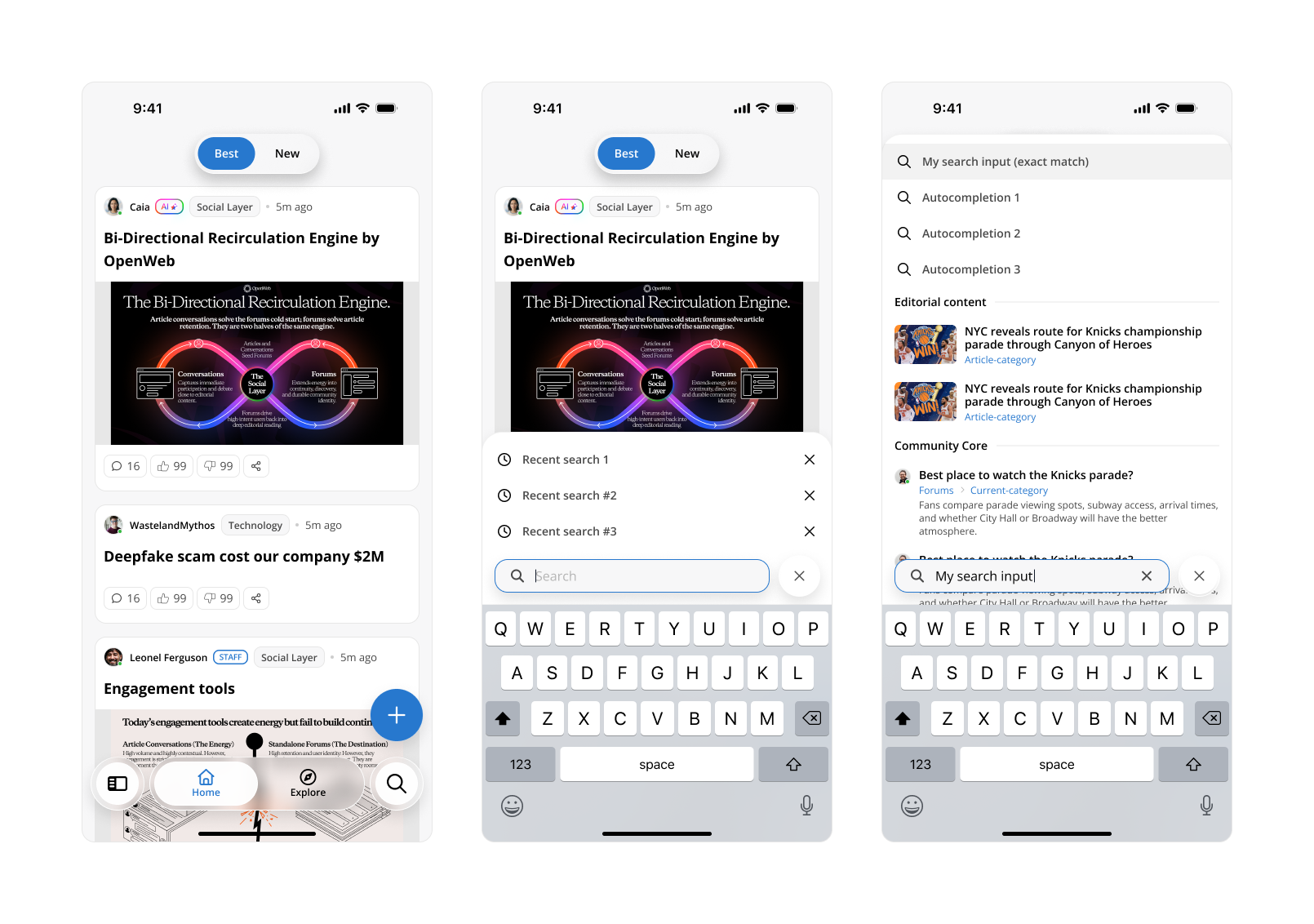
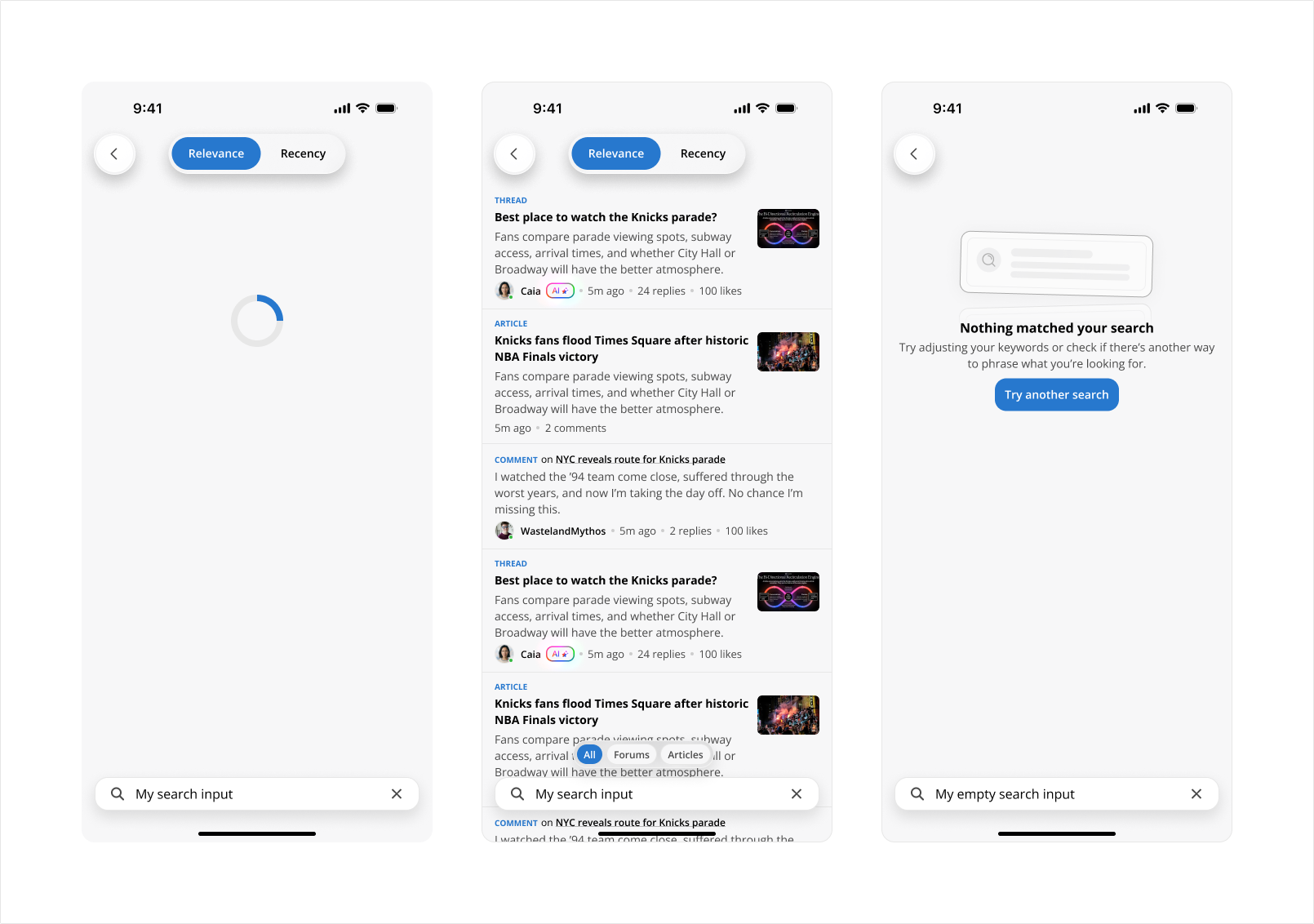
I defined Publisher Ecosystem Search as a unified search layer across everything OpenWeb held on a publisher’s site: Forums threads, comments inside threads, comments under articles, and the articles themselves. One query could return mixed community and editorial results, combining exact-term and semantic matching and ranking them by relevance.
The differentiator was the breadth of what became searchable from inside Forums. On a publisher’s Forums page, people could find discussions, comments, and articles without needing to know which surface held the original content. This was a Forums-exclusive capability: it made Forums the publisher’s search gateway across its OpenWeb content footprint—and gave publishers another concrete reason to enable the product.
Grouped autocomplete handled quick retrieval, while a full results page supported mixed content, relevance or recency sorting, and Forums or Articles filters.
05 · Launch
From a fragile beta to a product publishers could run.
I defined general-availability readiness around the gaps separating a functioning beta from a product publishers could repeatedly adopt and operate: a feed-first mobile experience, publisher-managed taxonomies, manual thread control, role-based thread creation, localization, technical stability, and demonstrated adoption.
The final product combined discovery, participation, identity, governance, publisher configuration, implementation, analytics, and monetization. Forums launched publicly on September 30, 2026 as part of OpenWeb’s Community Core proposition.
OpenWeb-reported results across selected beta partners
These are OpenWeb’s behavioral comparisons across selected beta partners. Axios separately reported that users who engaged with Forums spent three times longer on publisher sites and were twice as likely to register. The comparisons do not isolate Forums as the sole cause, but they show that the product attracted a materially more engaged audience where it performed best.
06 · Reflection
Shipping the request was not the same as proving the habit.
What I am proudest of
Forums was my first time leading an entirely new product rather than an isolated feature. I initially questioned whether I had enough product experience for its technical complexity, market uncertainty, and organizational pressure.
The project attracted constant questions, requests, bug reports, and competing opinions. The team had limited capacity, publishers had conservative brand-safety expectations, and Forums had to integrate with a large existing platform. I maintained a coherent direction, aligned the organization, and delivered close to the expected timeline.
I am equally proud that I stopped or changed work that was not earning confidence: synthetic discussion starters, standardized-only taxonomies, a navigation-heavy homepage, and further SEO investment without evidence.
What I would do differently
I would invest more in revalidating the end-user proposition before committing to the build. The original research happened in 2022, before generative AI significantly changed search, publisher traffic, and information discovery. By 2026, Reddit was already a global community for almost any topic and a highly visible source cited by AI products.
Publisher demand for UGC, first-party data, engagement, and SEO proved a business problem. It did not fully answer why readers would join and repeatedly return to a local community on a news or article site without a clear, differentiated advantage.
- What can a publisher-owned community offer that a global platform cannot?
- Which audience behaviors demonstrate repeat value rather than one-time curiosity?
- Which publisher strengths—expert access, trusted journalism, local identity, or exclusive participation—create that differentiation?
I would define the proposition from those findings and validate repeat behavior earlier. Shipping what customers request is not the same as proving that end users will build a lasting habit.
A product manager’s job is not to defend the original plan. It is to keep the problem, the evidence, and the shipped product connected.